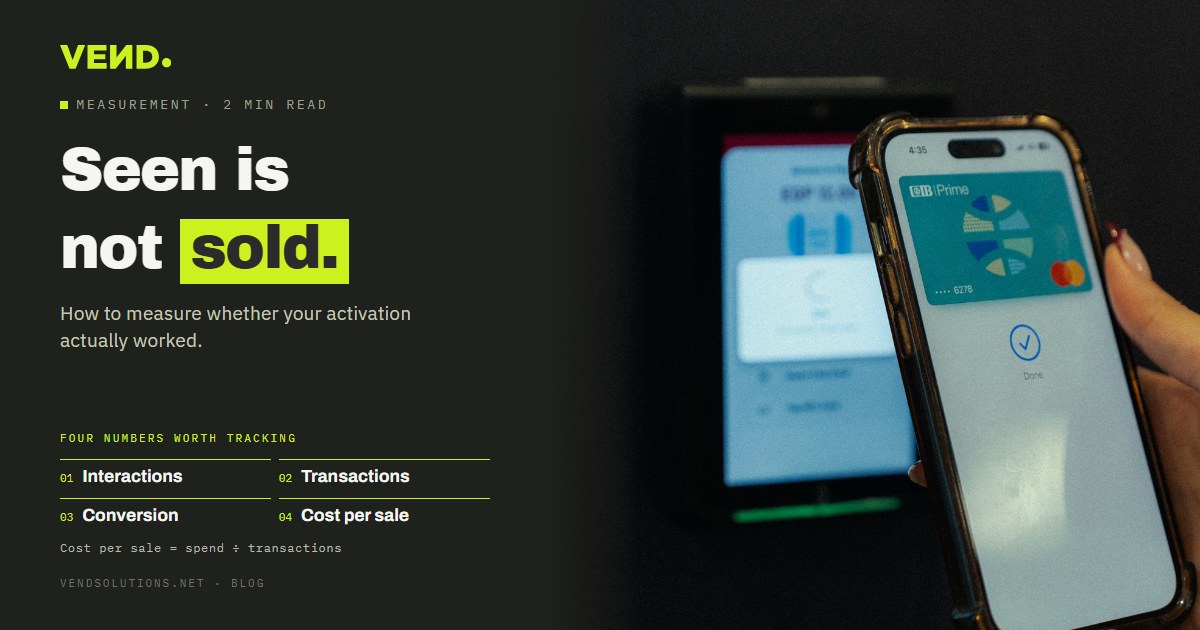
Short answer: To measure activation ROI, track how many people interacted, how many bought, and what each sale cost you. Divide your total spend by the number of transactions to get your cost per sale.
Picture this: A brand spends a month on a big billboard in Cairo and thousands of people drive past, and at the end of the month, the marketing manager is asked one question: “So, did it work?”
The honest answer is often “we think so.”
The problem with being seen
Outdoor advertising reaches people. That has real value, because awareness matters. But a billboard cannot tell you who looked, who cared, or who went on to buy. There is no product in anyone’s hand and no transaction to count.
The same problem shows up in many on-ground activations. A crowded stand, a tray of samples, and a happy photo can feel like success. Feelings are hard to put in a report.
Four numbers worth tracking
You do not need a complicated dashboard. Start with these.
- Interactions: How many people stopped, touched, or tried?
- Transactions: How many of them paid?
- Conversion: Transactions divided by interactions. This tells you how persuasive the moment was.
- Cost per sale: Your total spend divided by transactions.
Timing tells a story too
When people buy is as useful as how many. If most sales happen in the early evening, you know when to schedule staff, social posts, or promotions. If one location sells twice as much as another, you know where to invest next.
Where vending machines help
A VEND machine is a billboard that also sells. Every tap on the screen and every payment is logged with the time, date, product, and amount, then sent to the brand in weekly reports across locations. You also see live inventory, so a bestseller never quietly runs out.
That does not make awareness less important. It means you can finally pair awareness with a number.